Since 1 May 2025 every foreign national landing at Phuket International Airport must have submitted the Thailand Digital Arrival Card (TDAC) online before arrival — free, at the official tdac.immigration.go.th, within a 72-hour window before landing. After the aircraft door opens, passport control takes anywhere from under ten minutes to 90 on the worst high-season days, depending on how many international flights arrive alongside yours. This guide covers the decisions of that first stretch: how to read the arrivals schedule before you fly, what cash, exchange and SIM registration cost as of late August 2026 — with the ATM figures checked against a bank's published tariff — and which way out of the terminal is running when you clear the doors.
If you are flying out rather than in, you need the departure guide instead — our beach-by-beach leave-by table covers that direction. And if your flight lands after dark, read this together with the late-arrivals guide, because two of the transport options below stop running in the evening.
Before you land: the one form that saves you a queue
Thailand replaced the old paper TM6 arrival card with a digital one: every foreign national entering by air, land or sea must submit the TDAC online before arrival. The window opens 72 hours before you arrive, the form is free, and the only official site is tdac.immigration.go.th — anything that charges money for it is a middleman at best. You fill in passport details, your Phuket accommodation and a short health section, and receive a QR confirmation; a screenshot on your phone is fine, officers do not insist on paper.
Two details that most summaries skip. First, transit passengers who never pass immigration are exempt — if Phuket is only a connection and you stay airside, you do not need one. Second, forgetting it does not get you turned around: there are TDAC kiosks in the terminal, and you can also submit from your phone while standing in the immigration line. Treat both as fallbacks — kiosk lines can be slow at busy hours, a poor trade for three quiet minutes at home three days earlier. Set a reminder for the day the 72-hour window opens and do it then.
Immigration: what the line actually looks like
How long you stand at passport control depends almost entirely on whether your flight lands alone or inside a busy arrival period — a cluster of international flights reaching HKT together. Land in a gap and the whole thing can be over in under ten minutes. Land when three wide-bodies unload at once and the realistic planning range is 30–60 minutes, stretching to 90 minutes on the worst high-season days between November and April. Treat these as planning estimates, not measurements — where your flight sits relative to the clusters matters more than the season itself.
You cannot choose your slot after booking, but you can see it coming. Open our live arrivals board for your arrival day and count the international flights scheduled within about 45 minutes either side of yours: none or one, and the fast case is likely; two or three long-haul arrivals in that window, plan for the slow case and set the onward connection accordingly. Have the TDAC QR ready on your screen before you reach the desk, passport open at the photo page. Travelling with small children or with mobility needs, ask a member of staff whether a priority lane is open before joining the general queue — asking costs nothing.
One thing not worth paying for reflexively: third-party “fast track” meet-and-greet services. They do work, but outside the busy arrival periods they solve a problem you may not have — weigh the price against the queue your arrival slot actually predicts.
Baggage and customs: the short part
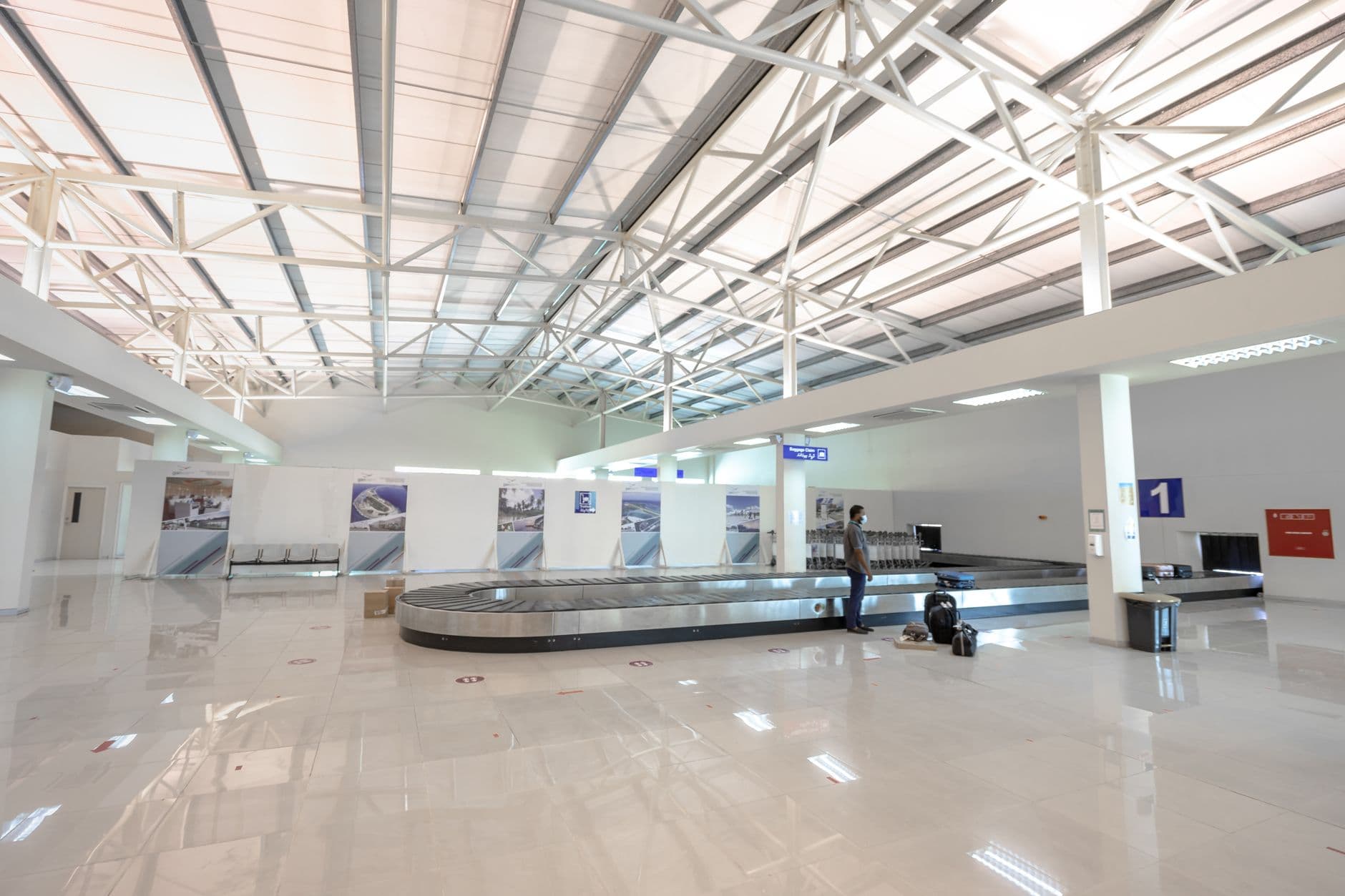
Baggage claim at HKT is usually the least of your problems — trolleys are free, and after a long immigration queue most bags are already circling by the time you reach them. Customs after that is a walk-through green channel for most travellers: use the red channel if you have anything to declare, and check Thai Customs rules for allowances, restricted goods and other declaration requirements rather than assuming duty-free limits are the only trigger.
Between baggage claim and the arrivals doors sit the ATMs, exchange booths and SIM counters. They deserve a section of their own — not because the airport marks everything up, but because the real costs here are set by card schemes, exchange spreads and package sizes, and two of the common rules of thumb about this area are out of date.
Cash, exchange and SIM: the 2026 fees
Three kinds of counter compete for your attention in the arrivals area: ATMs, currency-exchange booths and telecom stands. Here is what each costs as of late August 2026 — with the ATM figures taken from a bank's published tariff rather than travel-forum lore.
| What you need | What it costs | A lower-cost option to compare |
|---|---|---|
| Cash from an ATM | Thai banks price foreign-card withdrawals by card scheme, not location: SCB charges ฿250 on Visa and ฿350 on Mastercard per withdrawal (bank tariff in force since March 2026). The exact fee shows on screen before you confirm | Withdraw one larger sum instead of several small ones; secondary sources report AEON machines charging around ฿150, a figure we could not verify against the bank's own tariff |
| Exchanging notes | Airport booths are commonly reported to run about 3–5% below in-town rates (secondary sources) | Independent exchange offices in Patong and Phuket Town; change only a first-day amount at the airport |
| A tourist SIM | AIS and True counters after customs, packages roughly ฿299–1,699 | Convenience-store SIMs in town are a lower-cost option to compare for basic data; an eSIM bought before flying may cost less for a comparable plan |
The first thing to know about the ATMs is that the old “airport machines cost more” rule is not what the tariffs say. The fee for a foreign card is set by the bank that owns the machine, and it is set per card scheme, not per location. Siam Commercial Bank's published tariff for foreign cards — announced on 16 February 2026, in force since March 2026 — is ฿250 per withdrawal on Visa, UnionPay and JCB, and ฿350 on Mastercard, with no separate airport rate anywhere in the document. Other banks set their own tariffs, so the number that counts is the one on the machine: every ATM shows its charge on screen before you confirm, and that on-screen figure — not this article, not a forum thread — is the fact to act on. The often-quoted flat ฿220 predates the 2026 tariff change.
The second thing is dynamic currency conversion: an ATM or card terminal offering to charge you in your home currency instead of baht. Decline it every time — choose THB. The convenient-sounding option carries a markup usually put at 3–7%; treat the exact figure as an estimate, but on a ฿25,000 withdrawal even the low end costs more than the ATM fee itself.
On the SIM counters: they are legitimate and quick, and the paperwork is the same everywhere — a passport has been required to register any SIM in Thailand for years. What changed in August 2025 is the verification around it: since 18 August 2025 the telecoms regulator NBTC requires a biometric liveness check — a short face scan — for new registrations, and under the operators' current terms tourist SIMs are capped at 60 days' validity, with at most three SIMs per person per operator. None of that is airport-specific. What you pay the counter for is convenience, not coverage — the same networks sell smaller, cheaper packages in town, and an eSIM installed at home covers the first day and also gives you data for completing a forgotten TDAC in the immigration line.
How much cash do you actually need in hand when you step out? If your ride is prepaid or app-based, you may need very little — but payment acceptance varies, so do not land with nothing. If you plan to pay a driver in cash: for Patong, this article estimates ฿700–800 for a metered taxi including the airport surcharge — check the route-specific fare for other destinations — so a single withdrawal covers the first day comfortably.
Getting out: the doors, the desks and the clock
Which way out of the terminal is open depends on the clock. The full comparison lives on our airport hub and the dedicated taxi and limousine page; here is the summary, built around the cutoffs this guide can actually name: the Smart Bus runs 08:15–23:30, the transport desks work until midnight, and Grab — as of mid-2026 still the only ride-hailing app with an officially sanctioned pickup at HKT — is not tied to a timetable, though prices surge around busy arrival periods.
Before 08:15. The Phuket Smart Bus has not started its day — the first departure from the airport is 08:15. This guide does not have a fixed morning opening hour for the desks, so do not build an early-morning plan around them: a transfer booked in advance is the option you can fix beforehand, and Grab runs without a timetable.
08:15 to 23:30 — the bus window. Everything this guide names is running. The Smart Bus goes from the airport down the west coast to Rawai for a flat ฿100 — under the operator's timetable in force since 16 January 2026, roughly every 30 minutes, reaching Patong in about 90–110 minutes. The metered-taxi and AOT limousine desks are in the hall: a meter to Patong typically totals ฿700–800 including the ฿100 airport surcharge, while the limousine desk quotes fixed ฿800–1,000 to Patong and ฿1,000–1,200 to Kata or Karon. Shared minivans at ฿180–300 per person sit between bus and taxi on price, and leave when full.
23:30 to midnight. The bus has made its last departure; the desks work until midnight, and Grab keeps running — surge pricing around a late cluster of arrivals is common.
After midnight. The desks are closed and the bus is gone. If you expect to leave arrivals after midnight, the options stated here are Grab and a pre-booked transfer with a name board; the late-night taxi options and prices are covered in detail in our night guide. If your flight is scheduled to land after 23:00, book ahead — that fixes the price before you land.
A pre-booked private transfer is also the one option you can compare while still at home: live quotes for your exact flight and hotel run through GetTransfer, and each of our route pages carries the same booking form pre-filled for its beach. Travellers renting a car can compare offers through GetRentacar — follow the selected supplier's pickup instructions, as locations vary.
The arrival checklist
- Three days before flying: submit the TDAC at tdac.immigration.go.th the moment the 72-hour window opens. Screenshot the QR.
- Before landing: check the arrivals board: two or more international flights within 45 minutes of yours means planning for 30–60 minutes at immigration rather than ten.
- At baggage claim: trolleys are free; red channel if you have anything to declare, green otherwise.
- At the cash, exchange and SIM area: one withdrawal — the fee shows on screen before you confirm; decline the home-currency offer; change only a first-day amount; skip the big SIM package unless the counter's convenience is worth it to you.
- At the doors: between 08:15 and 23:30 every option is running, including the ฿100 bus; the desks close at midnight; after that — Grab, or the transfer you booked ahead.
Frequently asked questions
How long does it take to get through Phuket Airport after landing?
There is no reliable fixed touchdown-to-exit time: taxiing, deplaning and baggage delivery are additional to the immigration ranges in this guide, and none of them run to a schedule. Passport control itself, outside the busy arrival periods, is often under ten minutes; when several international flights land together, 30–60 minutes is a realistic planning estimate, and the worst high-season days between November and April can reach 90. Where your flight sits relative to those clusters — visible on the arrivals board before you fly — matters more than the season itself.
What happens if I forgot to fill in the TDAC before my flight?
You will not be sent back, but you will lose time: there are TDAC kiosks in the terminal, and you can also submit the form from your phone while standing in the immigration line, provided you have data — one practical argument for an eSIM installed before flying. Treat both as fallbacks, not a plan.